
April Plant of the Month – Winter Hazel
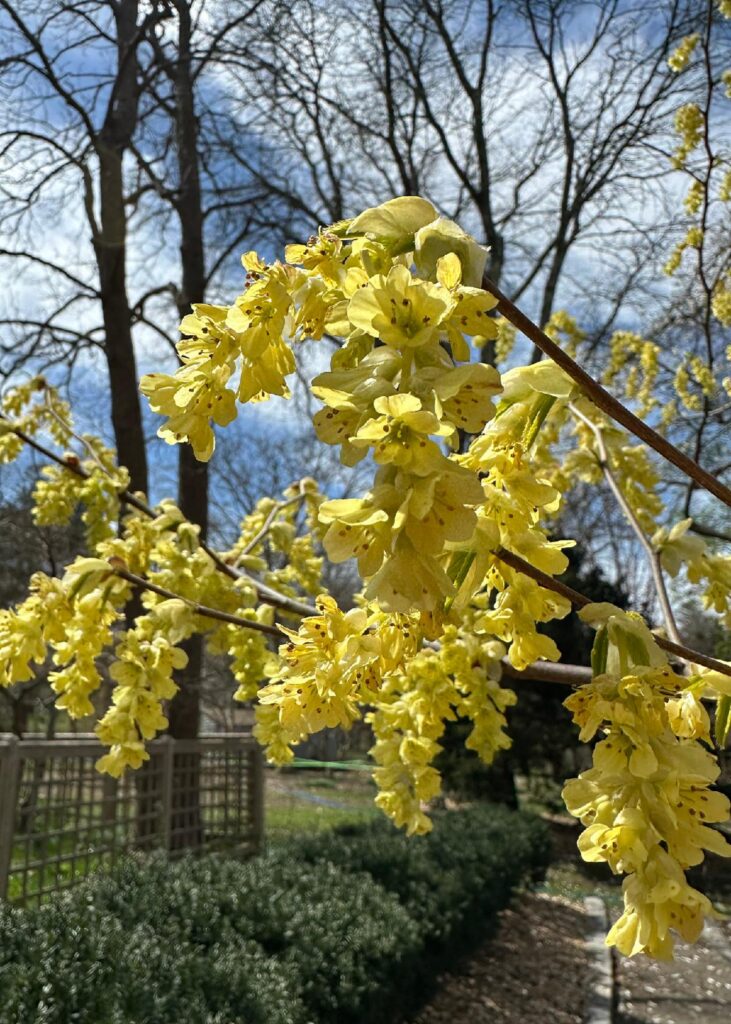
Corylopsis, commonly called winter-hazel, is a medium-sized shrub that grows best in full sun to part shade. The word Corylopsis derives from the Greek korylos (hazelnut) and opsis (resembling), meaning “resembling a hazelnut”. It is in the witch-hazel family, and shares several characteristics with witch-hazels (Hamamelis): late winter or early spring bloom, horizontal branching, and pest and disease resistance. All Corylopsis species grow best in light shade and moist, humus-rich, well-drained soil. The leaves, which resemble those of hazelnuts, are arranged in an alternate pattern on the stems and appear after flowering. Fall color ranges from green to straw yellow. Fruits are insignificant, greenish dry capsules. Winter-hazel is tolerant of many different soil conditions. Corylopsis spicata and Corylopsis pauciflora are both native to Eastern Asia. Fossils of the extinct Corylopsis reedae has been found in Washington State. These fossils are dated from the Eocene epoch, which is 56 million years ago. One of the noteworthy characteristics of winter-hazel is the beautiful yellow green, vaguely fragrant, bell-shaped flowers that emerge in mid April.
This spring our Corylopsis was heavy with flowers and almost glowed in the center of the formal gardens. At the arboretum, you can find two different species of Corylopsis, Corylopsis pauciflora and Corylopsis spicata, both are commonly called winter-hazel. Both species can be found within the formal gardens. They are considered low maintenance shrubs and both species grow no more than 10 feet tall. The new lane planting includes several Corylopsis.